

ANI-Gamut: Benchmarking Agent Reliability
across the Gamut of Agent–Network Interface Abstractions

Presenter: Stefano Salsano
- Professor of Telecommunications, University of Rome Tor Vergata; CNIT research unit lead
- Research: network programmability, SRv6, SDN/NFV, Linux networking; IETF contributor
- Current focus: agentic AI for network management and reproducible benchmarks
- Project page: netgroup.github.io/ani-gamut · stefano.salsano@uniroma2.it
22nd International Conference on Network and Service Management (CNSM 2026) · 27 October 2026, Alcalá de Henares, Spain
Key messages
1
LLM agents operate networks through some interface. Nobody has measured which interface level works best.
2
ANI-Gamut is an open-source playground for agentic network management; in this paper we change only the interface level and keep task, model and network fixed.
3
In our pilot, a higher-level interface succeeds where the raw shell fails, at a tenth of the cost; no collateral damage at any level.
At which level should the agent act?
- Attention goes to the agent; its contract
with the network stays implicit - Coding agents learned it:
the interface governs task success - ANI: Agent–Network Interface
the contract the agent acts through - Most existing work (e.g. IETF draft)
fixes the ANI at one level
Operators are climbing this ladder today. Which rung is safe to hand to an agent is being decided in practice.
The failure that matters: collateral damage
- Task done, unrelated service broken = an outage
- Two legs: reach the goal and touch nothing else
- Carrier grade: five nines
- Only visible on a brownfield:
a network already full of other services
Toy playgrounds hide the interactions we need to stress.
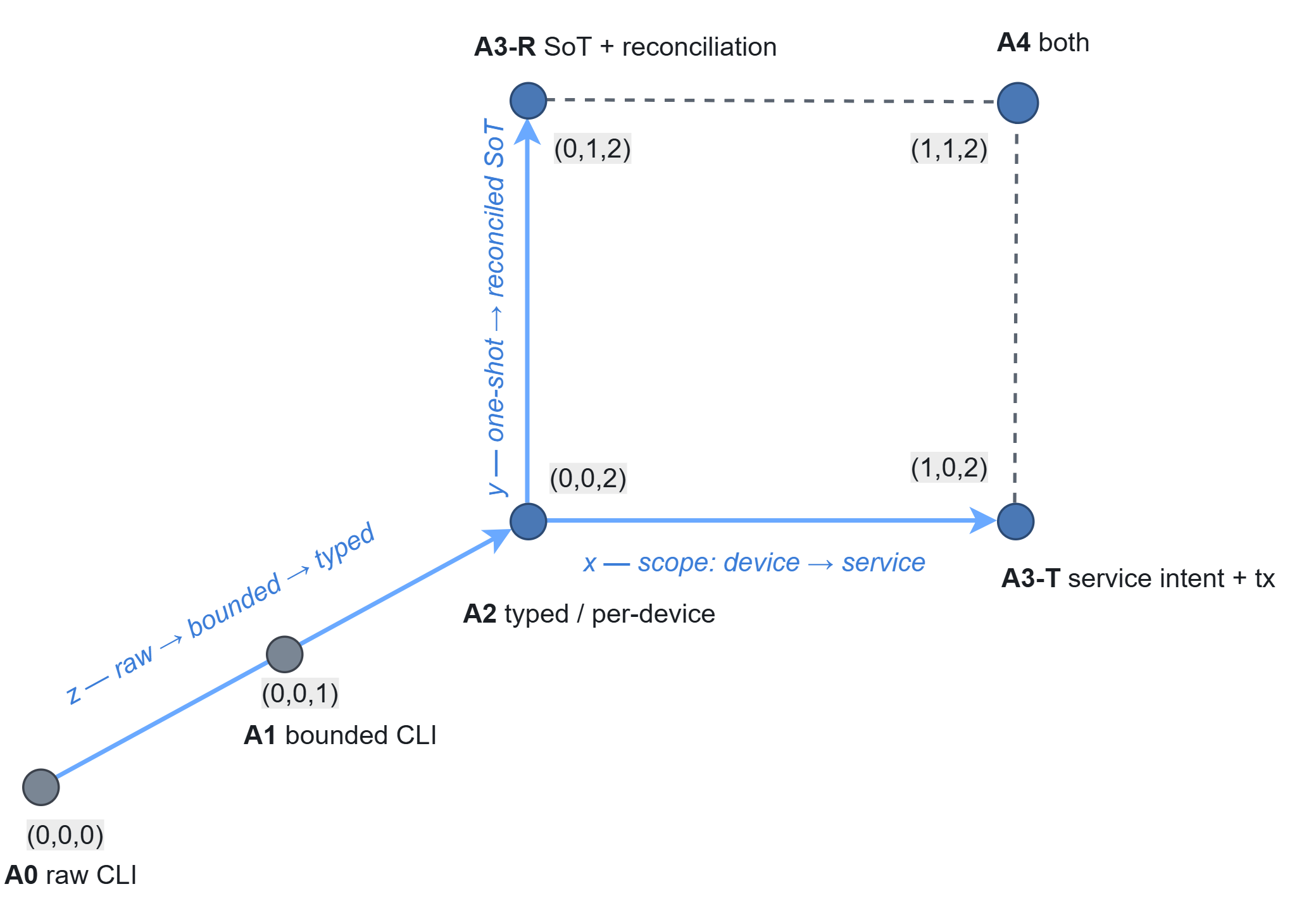
The spectrum: A0 to A4
- A0 raw shell · A1 bounded CLI
- A2 NETCONF/YANG, device commit
- A3-T service intent + transaction
- A3-R reconciled source of truth
- A4 both: commercial controllers like
Cisco NSO, Nokia EDA, Juniper Apstra
A ladder below, a plane above. A3-T and A3-R are two different bets on safety.
Nobody varies the interface
- Existing benchmarks: one fixed interface,
mostly troubleshooting - NetConfEval: levels compared,
but as static translation - OperAID: changing what the agent sees
moves success 11% → 61% - ALL populate little coexisting state
Production networks carry 105–106 config items. That density, not node count, is where damage happens.
One variable: the interface level
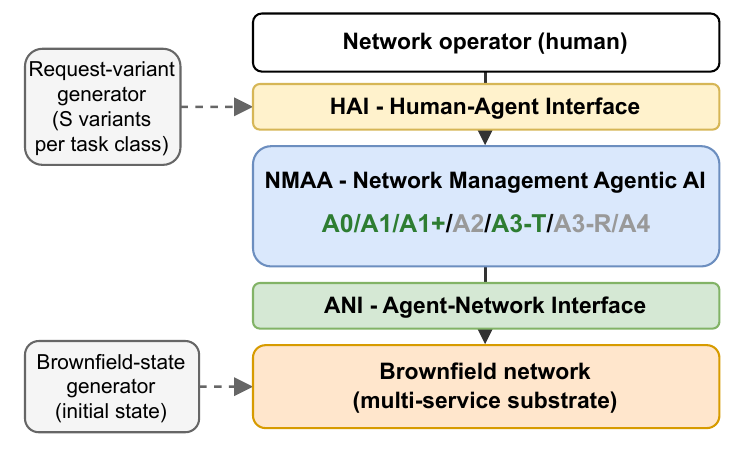
- HAI: the operator's request, fixed
- The agent: one model, fixed
- ANI: the level we vary
- Results checked from outside,
same at every level
Every level gets the same agent budget. Same model, prompt, step and token caps, retries. The only thing that changes between two runs is the action interface.
Same task, four implemented interfaces
| Level | What the agent sees | Safety mechanism |
|---|---|---|
| A0 | raw shell, every guardrail removed | none |
| A1 | free-text CLI, bounded | allowlist + snapshot / rollback |
| A1+ | A1 + hand-picked blocklist | ad-hoc prohibitions (control) |
| A3-T | typed service intent: provision_service | transaction + validation + rollback |
A2, A3-R conceptual; A4 future work. Built from our configuration harness (A1) and the MAIN 2026 SRv6 playground (A3-T).
A brownfield built like a Docker image
- Topology base + service-class layers
- Manifest in YAML: a brownfield Dockerfile
- Each layer: init · generate(seed) · verify
- Each layer also writes the checks
for its own services
~25 nodes, ~10 service classes, 103–104 items each. Density comes from configuration state inside the nodes, not from adding nodes.
Scoring: success vs. failure, safety vs. collateral damage
- Success = the requested service works
- Damage = a service that worked before no longer does
- Per run: damaged or not
- Safety metric: the fraction of damage-free runs
(good = 100%) - In the pilot we produced failures, never damage
Task success follows the level pilot
Change-set on a live 25-site tenant, n = 6 seeds:
task: add 2 sites, move 2, remove 1
| Level | Success |
|---|---|
| A0 raw shell | 0 / 6 |
| A3-T typed intent | 6 / 6 |
A0 gets ~85% of the sites connected on every seed, but never completes the task.
Cost follows the level pilot
- A0: 40 steps (the maximum), ~375k tokens
- A3-T: 3 steps, ~42k tokens
- Roughly 13× steps, 9× tokens
- Part of it is budget exhaustion: A0 fails at the cap
Why it is cheaper: the work moved from the agent to the automation layer. At A3-T the agent makes one
provision_service call; the command sequence, validation and rollback live in the automation layer, written once. At A0 the agent rebuilds them at every run.
Collateral safety does not follow the level pilot
- Damage-free runs: 100% at every level, on every task
- Agents fail safe: they give up,
they don't break neighbours - Tenants live in separate VRFs: nothing can leak
In this testbed tenants are isolated by VRFs, so there is no shared state an agent could break. Ongoing follow-up work: a shared firewall ruleset across tenants, where a careless agent can hurt its neighbours (stay tuned!).
Limits of this pilot
- Few runs: 20 / 6 / 4 per level. “No damage seen” is not “no damage”
- Few segments, not a curve: only A0, A1, A1+ and A3-T were run;
A2, A3-R, A4 were not - Emulated network: trust the gap between levels, not the absolute numbers
The gap between the ends is large and consistent; filling the middle is the next step.
Released as open source: build on it
Harness and per-level adapters: add a level, a model, a task class
Brownfield generator: add a service class, change density, replay a seed
github.com/netgroup/ani-gamut · playground, pre-registration and extended version at netgroup.github.io/ani-gamut
Take-home
1
Treat the agent–network interface as a first-class experimental variable.
2
Task success and cost track it: 0/6 → 6/6 at a tenth of the cost.
3
Collateral safety was set by the network isolation, not by the agent. Next: shared state, A2 and A3-R implemented, density and fault sweeps.
4
We need realistic testbeds, with complexity comparable to production networks.
Thank you. Questions?
Playground, pre-registration, extended version: netgroup.github.io/ani-gamut
Which levels were run in which experiment pilot
| Experiment | A0 | A1 | A1+ | A3-T |
|---|---|---|---|---|
| Benign onboarding, n = 20 | 0.20 | 0.35 | 0.55 | not run |
| Change-set, live tenant, n = 6 | 0 / 6 | not run | not run | 6 / 6 |
| Onboarding under faults, λ = 0.3, n = 4 | 0 / 4 | 2 / 4 | 1 / 4 | 4 / 4 |
| Damage-free rate, all of the above | 1.00 | 1.00 | 1.00 | 1.00 |
The headline contrast is A0 vs A3-T because the change-set task was run only at the two ends. A1 and A1+ appear in the benign and fault experiments; A2, A3-R and A4 were not implemented. Shared seeds at each level → paired McNemar test (change-set: p = 0.031 on six discordant pairs).
Benign onboarding, no faults pilot
| Level | Success | Wilson 95% |
|---|---|---|
| A0 | 4/20 · 0.20 | [0.08, 0.42] |
| A1 | 7/20 · 0.35 | [0.18, 0.57] |
| A1+ | 11/20 · 0.55 | [0.34, 0.74] |
- McNemar A0 vs A1+: p = 0.092 (trend); A1+ vs A1: p = 0.289
- Tokens +62% from A0 to A1; damage-free 1.00
Benign tasks show the trend, not the separation.
Why we inject faults
- On a healthy network, A0 and A3-T differ mostly in cost
- Real networks lose packets, lose links, freeze nodes
- Question: does the interface level still matter when the network misbehaves?
- Fault rate λ is a stress knob, set above realistic levels on purpose
Same task (tenant onboarding), same model, same budget, same seeds. Only the level changes.
How faults are injected
- Faults: packet loss, latency, downed link,
frozen node, daemon restart, held lock - Injected in the shared substrate,
below every adapter - Never inside a level: that would test
the level’s own resilience - Seeded: the same fault sequence
is replayed at every level
Every level sees the same event at the same moment. Partial apply, double apply, lockout are outcomes we measure, not inputs.
Results under injected faults
Onboarding task, λ = 0.3, n = 4 per level, one model, same budget:
| Level | Success | Damage-free | Steps | Tokens |
|---|---|---|---|---|
| A0 | 0 / 4 | 100% | 25.0 | 127k |
| A1 | 2 / 4 | 100% | 25.0 | 228k |
| A1+ | 1 / 4 | 100% | 25.0 | 239k |
| A3-T | 4 / 4 | 100% | 5.5 | 35k |
- A3-T completes every run; A0 none; A1 and A1+ in between
- No level damaged a pre-existing tenant, even under faults
- A3-T sends a typed intent and does not need to read the degraded network;
A0 and A1 do, and lose their way
Caveat. Four runs per level; and typed intent, transactions and the actuation channel change together, so this pilot does not say which one does the work.