LLM agents increasingly act on live networks: they read state, change configuration, and verify the result. A first-order question is usually left implicit: at which level of abstraction should the agent operate?
The same change can be presented to an agent as a raw device shell, as a typed declarative service request, or as an edit to a reconciled source of truth. These are very different contracts between the agent and the network. ANI-Gamut makes that level the variable we vary, holding the task, the model, and the observation interface fixed, and reads off reliability, safety, recovery, and cost.
Paper (CNSM 2026) · Extended version (PDF) · arXiv · Analysis plan · Talk · Code
The interface-abstraction spectrum
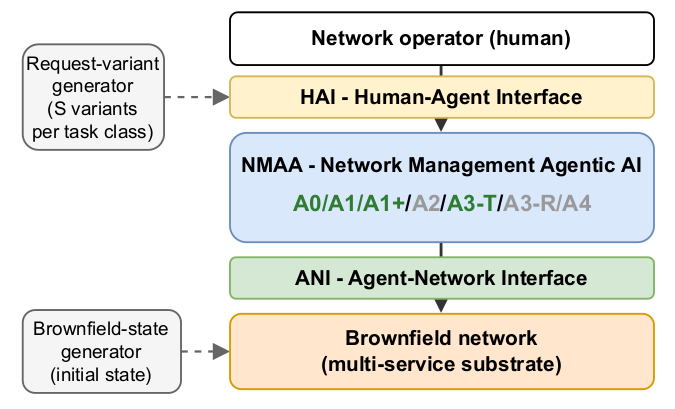
Green: implemented in ANI-Gamut · grey: conceptual.
The playground
A realistic brownfield
A single, densely populated multi-service substrate where many coexisting services share resources, so a careless change can shadow a prefix, reuse an identifier, or trip a global knob. This is where collateral damage actually arises, and where toy playgrounds hide it.
The same task, at every level
One harness exposes an identical configuration task to the agent through a per-level adapter, on one emulated testbed. Released as open source so the community can reproduce, extend, and compare.
The metric
Safe configuration is a zero-tolerance property: an agent that completes its task but silently breaks an unrelated, already-deployed service has caused an outage, not a success. The headline metric is therefore not mean task completion but the rate of damage-free runs, estimated with tail-aware statistics as the substrate is stressed by rising state density and injected faults. The hypothesis under test is that raising the interface level shrinks the agent’s blast radius, a structural safety gain that ad-hoc guardrails approximate but do not match.
Paper and resources
- Paper. L. Bracciale, P. Loreti, A. Mayer, S. Salsano, W. Henderickx, “ANI-Gamut: Benchmarking Agent Reliability across the Gamut of Agent–Network Interface Abstractions,” International Conference on Network and Service Management (CNSM 2026), Alcalá de Henares, Spain, October 2026.
- Extended version (full methodology, system architecture and appendices): PDF, v2 of 28 October 2026 · arXiv:2609.22723 (v2 pending announcement).
- Hypotheses and analysis plan: as stated in Section VI of the paper, with the part of the plan executed in the pilot.
- Talk: CNSM 2026, Full Paper Session 2 “AI for Networks”, 27 October 2026 — slides.
Code
The playground (harness and per-level adapters, scenario generator, SRv6 substrate) is released as open source in the netgroup/ani-gamut repository, tag cnsm2026 (playground/: Apache-2.0; substrate/: GPL-3.0).
How to cite
@inproceedings{bracciale2026anigamut,
  author    = {Bracciale, Lorenzo and Loreti, Pierpaolo and Mayer, Andrea and Salsano, Stefano and Henderickx, Wim},
  title     = {{ANI-Gamut}: Benchmarking Agent Reliability across the Gamut of Agent--Network Interface Abstractions},
  booktitle = {International Conference on Network and Service Management (CNSM)},
  address   = {Alcal\'a de Henares, Spain},
  year      = {2026}
}
Acknowledgment
This work has received funding from the Italian MUR PRIN NEWTON project.